.png)
Intuitive Psychology Coach: What the Credential Means and Why It Matters for Leaders
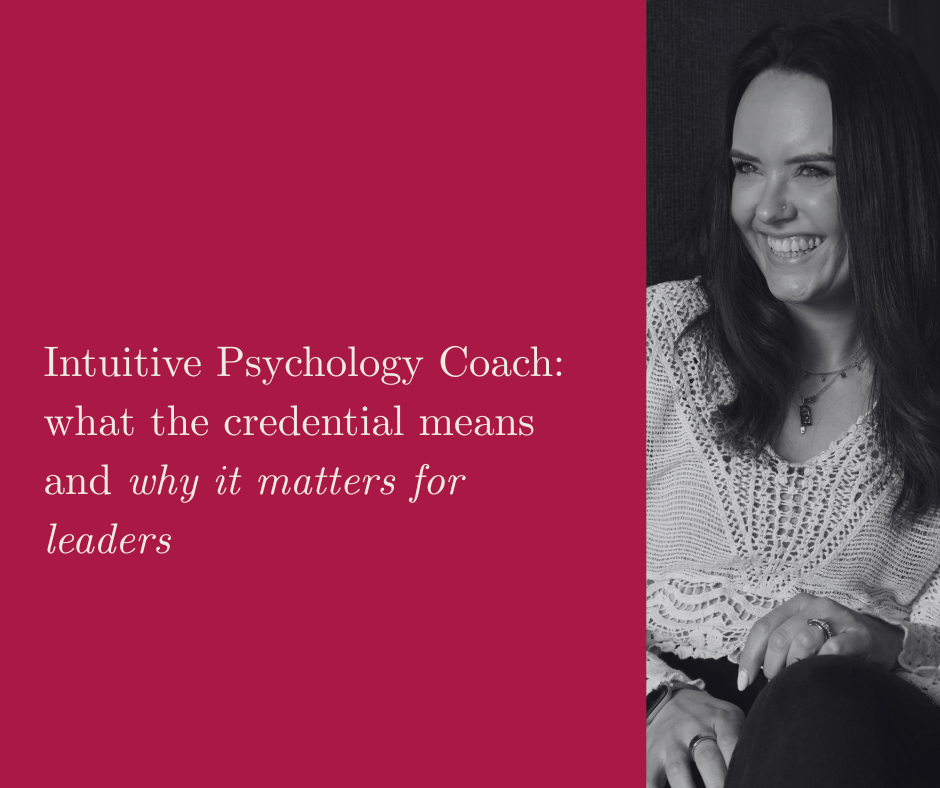
In short: an intuitive psychology coach is a practitioner trained to work with both psychological insight and intuitive intelligence — the subconscious processing that sits beneath conscious thought — rather than with frameworks and accountability alone. It is a recognised, accredited discipline, not a loose label. The Intuitive Psychology Association is currently the only organisation that trains and accredits coaches in it, and its training is accredited by the Association for Coaching.
That matters, because "intuitive coach" has become a title anyone can print on a website. You go looking for something deeper than the usual executive coaching — something that reaches the part of you that already knows what to do but can't act on it — and find a wall of people promising transformation with no visible training behind it. For a leader who makes defensible decisions all day, that's a credibility problem.
What is an intuitive psychology coach?
An intuitive psychology coach works at the intersection of two things most coaching keeps separate: evidence-based psychology, and the intuitive intelligence your brain runs whether you acknowledge it or not.
Intuition isn't mystical — it's neuroscience. Roughly 95% of your mental processing happens below conscious awareness, where every pattern you've absorbed about risk, authority, failure and belonging is stored — quietly shaping decisions you believe you're making rationally.
Most coaching works at the level of behaviour: what you do, what you commit to, what you report back next session. Intuitive psychology coaching works a level beneath that — at identity, belief, and nervous-system state. The question shifts from what should I do? to why can I see the right answer and still not move on it? That's a different kind of conversation, and it needs a practitioner trained to hold it.
Is intuitive psychology coaching accredited?
Yes — and this is the part worth checking carefully. Intuitive Psychology Coaching is accredited by the Association for Coaching, one of the UK's established professional coaching bodies, and accredited practitioners work within the Global Code of Ethics for Coaches and Mentors. Training runs from foundational level through to the Master Diploma.
When you're vetting someone, three questions do most of the work:
- Where did you train, and at what level? A named institution and qualification, not "years of experience".
- Which professional body accredits that training? In the UK: Association for Coaching, ICF or EMCC.
- What's outside your scope? A trained coach answers instantly and without defensiveness.
If those answers are vague, you're not dealing with a discipline — you're dealing with a brand. (More on this in how to choose an executive coach.)
What's the difference between an intuitive psychology coach and a life coach?
A life coach typically works forward from goals: clarify the outcome, build the plan, hold you accountable. Useful — and for plenty of problems, enough.
An intuitive psychology coach starts with the pattern underneath the goal. Why this ceiling, repeatedly? Why does saying no cost you so much? Why does the decision you keep deferring feel disproportionately heavy?
The difference shows up in what you leave with. A goal-led session gives you a plan. This work removes whatever made the plan impossible to execute — usually not a planning problem at all. It's also distinct from therapy, which is clinical and a different profession entirely; more on that line in executive coaching vs therapy.
What does a Master Intuitive Psychology Coach do differently?
Master level is the highest accreditation tier in this modality — and in practice it changes the depth a coach can safely work at, not just the letters after their name.
I'm one of the world's first accredited Master Intuitive Psychology Coaches. I'm also a founder and CEO — I run HubGem, recognised as WorkL's #1 World's Happiest Workplace 2026 and a top 1% global HubSpot partner. I mention that deliberately, because the leaders I coach can tell within ten minutes whether someone has actually carried the weight of a payroll, a board, a difficult exit. Training without lived leadership experience produces coaching that's psychologically sound but commercially naive. Experience without the training produces mentoring dressed up as coaching. The combination is the point.
If you're sitting with that gap between external success and internal depletion, the free From Burnout to Fulfilment workbook is a good place to start.
Why would a CEO choose an intuitive psychology coach?
Because by this level, the bottleneck has stopped being information. You know what the data says. You know what your advisors would recommend. What you're navigating is the gap between knowing and acting — and that gap is held in place by identity ("if I stop pushing, who am I?"), by belief ("I can't be the kind of leader who says that"), and by a nervous system that has run on elevated alert so long it now reads calm as danger.
Trained intuition is also a leadership asset in its own right. The strongest executives decide using both rigorous analysis and a well-calibrated internal signal — and can tell that signal apart from anxiety. That calibration is trainable. It's much of what The Intuitive CEO Method is built to do, and there's more on the modality itself at what is intuitive psychology coaching.
Reflection
Before you go looking for a coach, sit with these:
- Where in your leadership do you already know the answer — and still haven't moved?
- When you last ignored your instinct and went with the "sensible" option, what did that cost?
- If the next version of you didn't need to prove anything, what would you decide differently this quarter?
Frequently Asked Questions
Is intuitive psychology coaching the same as therapy?
No. Therapy is a clinical profession treating mental health conditions, often working with the past; intuitive psychology coaching is non-clinical, forward-focused work with high-functioning people. An ethical coach refers you to a clinician when that's what's needed.
Do I need to believe in anything spiritual for this to work?
No. Intuition here means subconscious pattern recognition — your brain integrating far more data than conscious attention can hold. The work is grounded in neuroscience and psychology, and requires no belief system.
How do I check that a coach is genuinely accredited?
Ask for the training provider, the qualification level and the accrediting body, then verify it independently. In the UK the Association for Coaching, ICF and EMCC are the recognised bodies; for intuitive psychology specifically, accreditation runs through the Intuitive Psychology Association.
Is this only for founders, or also for senior corporate leaders?
Both. Founders and executives inside larger organisations face different structures but a similar internal problem: high visibility, high responsibility, nowhere to think honestly. The executive coaching for founders and senior leaders page sets out how the work is shaped for each.
How quickly do leaders notice a difference?
Most notice a shift in how a specific decision feels within the first few sessions — the charge comes off it. Deeper identity-level change takes weeks to months, and shows up first in what you stop tolerating.
Where to go next
Not ready to talk yet? Subscribe to the blog, and follow on Instagram and LinkedIn.
Ready to go deeper? Look at the 1:1 coaching programmes, or book a discovery call — a free, no-pressure conversation about whether this work is the right fit. If it isn't, I'll say so.
You don't need another framework. You need the thing underneath it to stop getting in the way.